
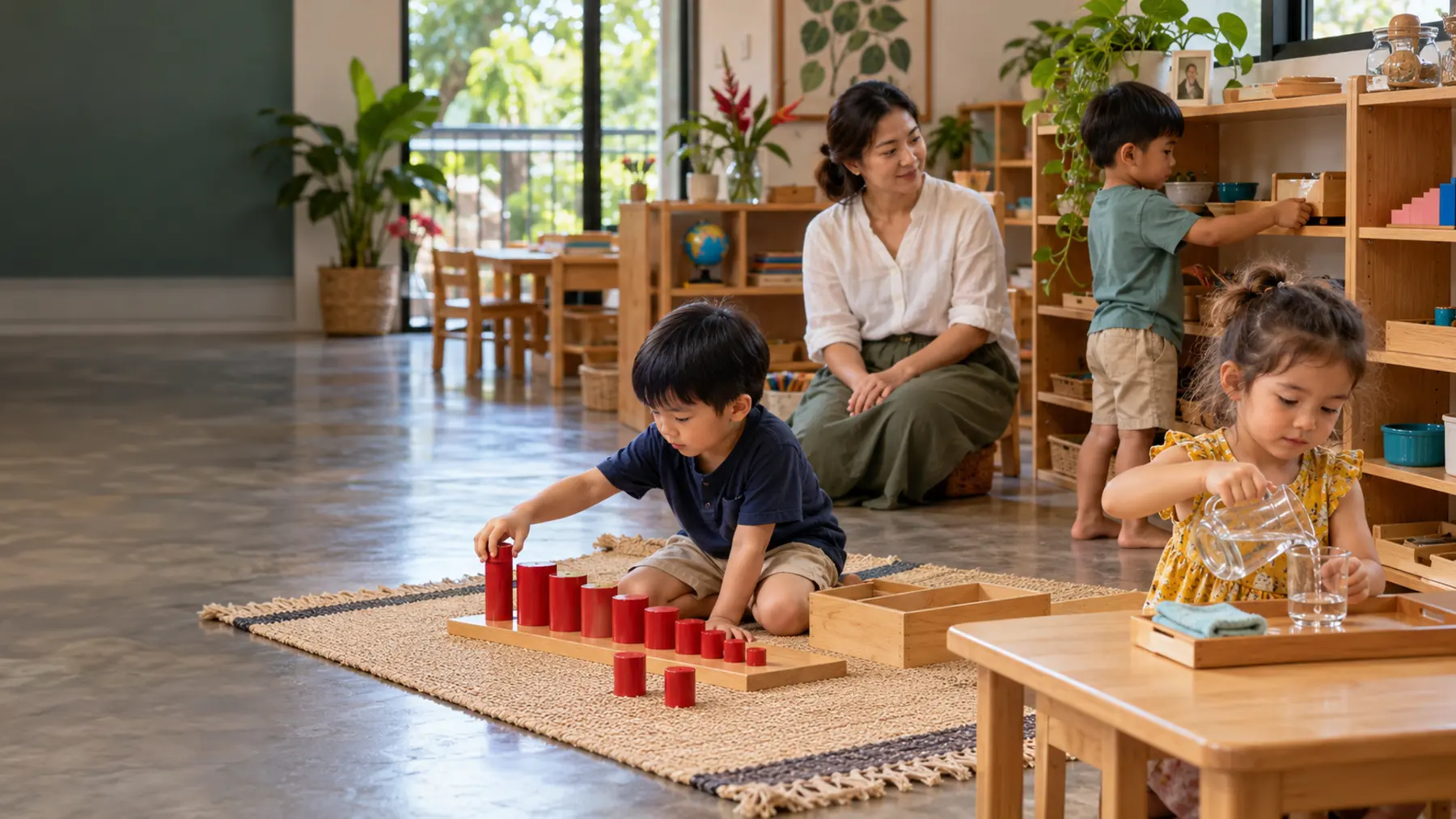
A parent walks into a preschool and sees low wooden shelves, child sized tables, neatly arranged trays and a calm neutral room. “This looks Montessori,” the parent says. “I like it. I think I want to enrol my child.”
The attraction is understandable. The room appears orderly, thoughtful and respectful of children. Yet appearance and educational practice are not the same thing.
The deeper question is not whether the furniture is wooden. It is whether the child is trusted to make meaningful choices, work at an individual pace, care for the environment and grow increasingly independent.
The short answer
Montessori is not a classroom style. It is a set of beliefs about child development, choice and repetition, adult guidance, concentration, responsibility and freedom within clear limits.
A preschool can own beautiful materials and still operate mainly through adult directed group lessons. Another school may look less fashionable yet apply Montessori principles with great integrity. The label and the look are only a starting point.
Montessori has become an aesthetic
Social media has made the Montessori look instantly recognisable: pale timber, baskets, muted colours, open shelves and carefully displayed materials. These features can support a prepared environment, but none proves that Montessori is happening.
A low shelf does not tell you who chooses the activity.
A wooden tray does not tell you whether the child can repeat the work.
A quiet room does not tell you whether concentration is protected.
A child sized table does not tell you how adults respond to mistakes.
To understand the approach, parents need to look beyond what is in the room and notice how the room is used.
What makes a Montessori environment different?
A prepared environment
The room is organised so children can find, use and return materials with increasing independence.
Specially designed materials
Materials isolate particular concepts and often allow children to notice and correct an error without waiting for an adult.
Meaningful choice
Children choose from activities that have been prepared and presented, rather than following one identical task together.
Uninterrupted work
Long work periods allow children to settle, repeat, concentrate and reach a deeper level of engagement.
Mixed age communities
Younger children observe older peers while older children practise responsibility and leadership.
A trained guide
The adult observes carefully, presents materials precisely and decides when to step in, step back or offer the next challenge.
Child centered means more than child friendly
A child centered classroom does not simply contain pleasant activities. It allows different children to be working on different things because their interests, readiness and pace are not identical.
One child may be working with number materials. Another may be pouring water. A third may be practising language while another observes before choosing. The whole class does not necessarily move through the same lesson at the same time.
For some families, this is exactly the respect for individuality they are looking for. For others, it can feel less predictable than a timetable in which every child completes the same page or product.
Does choice mean anything goes?
No. Montessori offers freedom within limits. Children choose from an intentionally prepared range of activities. They learn how to use materials respectfully, avoid disturbing others and restore the environment when they finish.
The teacher also watches for patterns. If a child repeatedly avoids language or mathematics, the response is not simply to leave the child alone. A skilled guide looks for the reason, presents an inviting entry point and supports a balanced path of development.
The teacher may be doing more than parents see
Montessori teaching can look quiet from the outside. The adult may not stand at the front delivering a long lesson to the entire class. This does not mean teaching is absent.
The teacher is continually deciding
- Which skill the child appears ready to learn
- Whether help will support or interrupt concentration
- When an activity has become too easy or too difficult
- Which area the child has been avoiding
- When to present a new material
- How to protect both freedom and responsibility
Parents should therefore ask about teacher training and observation. The quality of Montessori depends greatly on the judgement of the adults, not only on the materials they own.
Independence does not mean doing everything alone
Independence is sometimes misunderstood as withdrawing help. Healthy independence means giving a child the smallest useful amount of support, then allowing time to try.
Children may learn to carry their belongings, pour a drink, prepare a snack, wash, dress, choose work, persist, return materials and ask for help appropriately. These practical skills communicate something larger: you are a capable member of this community.
Montessori may challenge parents as much as the child
The approach asks adults to tolerate a slower pace. It asks them to resist correcting every imperfect attempt, allow safe struggle, value repetition and trust quieter forms of teaching.
It may also ask families to think differently about rewards, comparison and visible output. A child who repeats the same practical task for several days may be building coordination, order and concentration even when there is no worksheet to bring home.
Where are the academics?
Authentic Montessori includes rich work in language, mathematics, sensorial development, practical life and culture. Many concepts move from concrete materials toward abstract understanding.
The academic pace is often individual. A child may progress quickly in one area and spend longer consolidating another. This can be a strength, but parents should still ask how the school observes progress, ensures breadth and communicates what the child is learning.
Does Montessori include play?
Montessori includes choice, movement, exploration and hands on discovery, although purposeful activity is often described as work. Traditional Montessori environments may place greater emphasis on real life tasks and specially designed materials than on open ended fantasy play.
Families who strongly value dramatic play, changing monthly themes or large collaborative projects should ask how these experiences appear in a particular school. Difference does not automatically mean one approach is better. It means the family needs to understand what it is choosing.
Will Montessori suit every child?
Be cautious of simple personality checklists. Active children, shy children and highly social children are not automatically a fit or a poor fit. The quality of the environment, the skill of the teacher and the needs of the particular child matter greatly.
Children who enjoy choosing, repeating, handling concrete materials, finding order and taking practical responsibility may respond especially well. Yet the better question is whether this specific school can understand and support this specific child.
Will Montessori suit the parents?
This question receives far less attention, although it can decide whether the relationship with the school remains trusting.
Parents may admire Montessori in principle while expecting a teacher to direct most of the day, every child to study the same topic, frequent worksheets, identical crafts, quick acceleration, public rewards or immediate adult help.
The child may be comfortable, but the parents may not be.
A child may be happily concentrating and progressing while the parent worries that the class is not moving through one common topic. A child may be building coordination through practical life while the parent expects visible reading or mathematics on paper. A teacher may be observing and waiting while the parent expects the child to be pushed toward an immediate outcome.
In each case, the programme may be working as intended. The discomfort comes from a difference between the school's beliefs and the parent's expectations.
Montessori might not fit your expectations if...
You want the whole class to progress together
Montessori usually allows children to work at different levels and on different activities within the same community.
You expect the teacher to determine most of the day
The adult prepares and guides, but the child is expected to exercise meaningful choice.
You need academic work to be immediately visible
Important development may happen through concentration, practical activity and concrete materials before it appears on paper.
You expect acceleration on demand
The approach follows readiness and mastery rather than moving ahead simply to produce a faster visible result.
You are uncomfortable with repetition
Repeating one activity can be the way a child builds control, confidence and deep understanding.
You want frequent rewards or public recognition
Montessori generally encourages satisfaction in mastery and contribution rather than external prizes or ranking.
You want a highly thematic programme
Some families prefer changing themes and large shared projects. Ask how much these appear in the school you are considering.
You prefer adults to help immediately
A Montessori guide often pauses to see what the child can attempt before offering assistance.
The family's educational beliefs matter too
Before enrolling, parents can test their own comfort with the approach. These questions are not designed to produce a right answer. They help reveal alignment.
Am I comfortable with my child making meaningful choices?
Can I accept that children in one class may progress at different rates?
Can I value growth that does not arrive home on paper?
Can I allow my child to struggle safely, repeat and master?
Am I comfortable with fewer rewards and comparisons?
Do I prefer individual pathways or shared class experiences?
Will we support growing independence at home?
What evidence of progress will help me trust the process?
A beautiful mismatch is still a mismatch
Sometimes parents enrol because they love the look of the room, then gradually ask the school to become something it was never designed to be. They request more whole class instruction, more worksheets, faster academic progression or more teacher led work.
These preferences are not wrong. They may simply belong to a different educational approach. It is kinder to the child, family and school to discover that difference before enrolment.
The best preschool is not the one with the most admired label. It is the one whose beliefs align with what your family is prepared to trust.
What should parents ask a Montessori preschool?
Questions worth taking on a school visit
- What Montessori training do the teachers have?
- How long is the uninterrupted work period?
- Are the classes mixed age, and how does that work?
- What can children choose, and what are the limits?
- What happens when a child avoids an area of learning?
- How are language and mathematics introduced and monitored?
- How is progress documented and shared with families?
- What place do imagination, dramatic play and projects have?
- Which elements are authentically Montessori and which are adapted?
- What independence is expected at different ages?
Montessori or Montessori inspired?
Some schools follow a recognised Montessori model closely. Others borrow selected ideas such as child sized furniture, practical life activities or self correcting materials while combining them with other approaches.
Adaptation is not automatically a problem. The important thing is honesty. Parents should be able to understand which principles are central, which have been modified and what the daily experience actually looks like for a child.
The question behind the beautiful room
Look past the timber shelves and ask what adults genuinely allow. Do they let children choose? Do they protect concentration? Do they observe before intervening? Do they value repetition? Do they respond to individual pace? Do they expect children to care for their shared community?
Montessori may be an excellent fit when it is authentic, well implemented and aligned with what a family believes. It should not be chosen only because the classroom photographs are beautiful. Nor should it be rejected because of a simple assumption about freedom or academics.
Observe the teacher. Ask how choice and progress are balanced. Notice whether respect flows in both directions. Then decide whether this is the kind of learning relationship you are ready to trust.
Montessori is not defined by how the classroom looks. It is defined by how deeply the adults respect the child's capacity to choose, concentrate, practise and become independent.