
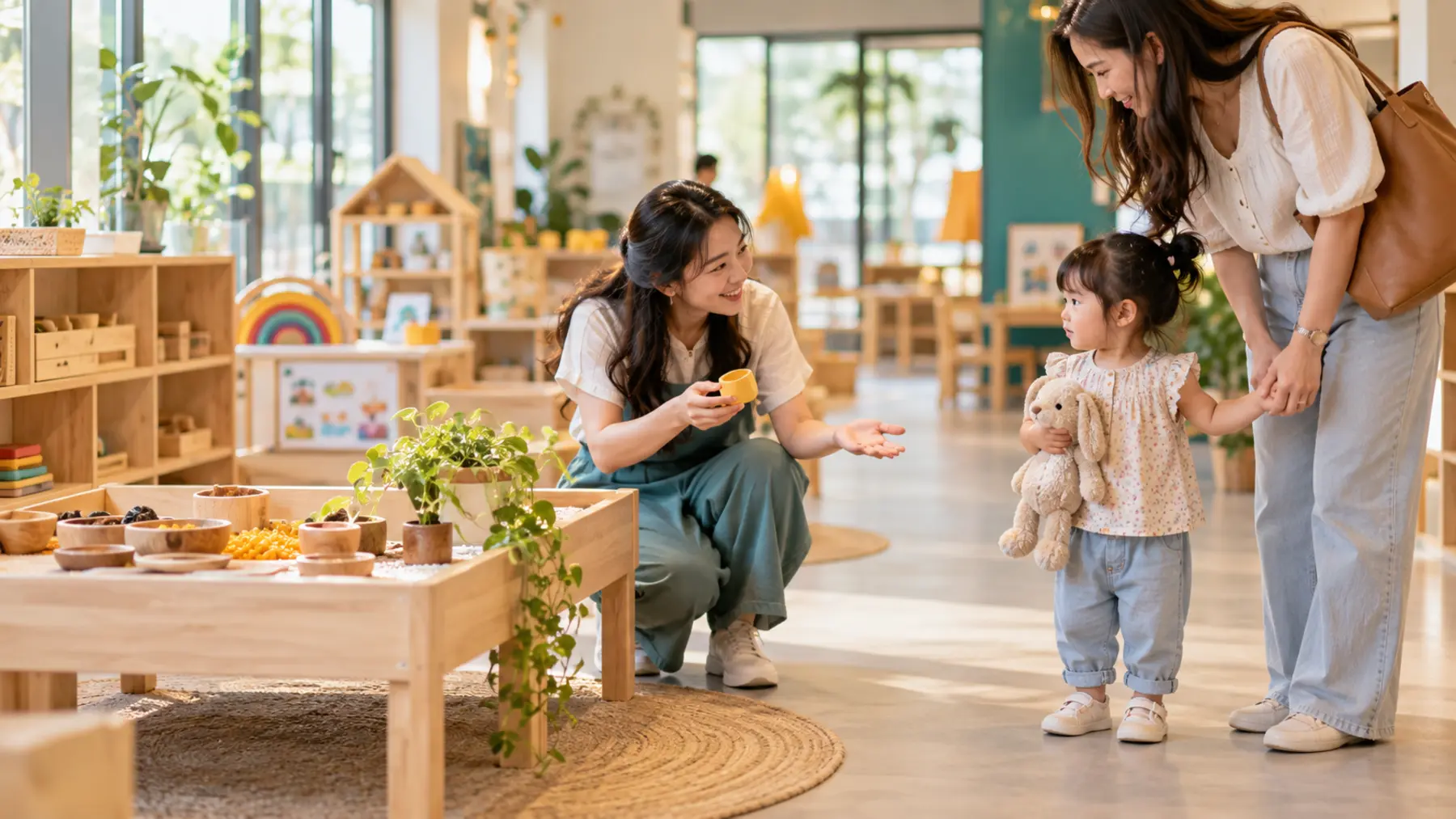
The question usually arrives quietly. Perhaps your child has begun watching other children at the playground. Perhaps grandparents are asking when preschool will begin. Or perhaps you simply wonder whether home is still enough for the child who now wants to touch, carry, ask and do everything.
Parents often imagine preschool readiness as a list of things a child should already be able to do. Speak clearly. Share nicely. Sit through a lesson. Separate without tears. Use the toilet alone.
At two, that is rarely how development works. A more useful question is not, “Can my child manage preschool perfectly?” It is, “Is my child beginning to benefit from a wider world, with the right adult beside them?”
Preschool readiness is not a performance children pass before they enter. It is something that grows through a safe beginning.
What readiness can look like at two
You may notice only one or two of these signs. That can still be a meaningful beginning.
Your child is curious about what other people are doing
They watch children play, follow an adult’s actions or move closer to something interesting.
They can communicate a need in their own way
A word, gesture, expression, sound or pointing finger can all be communication.
They are beginning to enjoy simple routines
They recognise what happens next during meals, bath time, packing up or getting ready to go out.
They attempt small things for themselves
They may try to hold a cup, carry a bag, remove a shoe, wash their hands or return an object.
They can accept comfort from another trusted adult
It does not need to happen immediately. What matters is that trust can begin to form.
What your child does not need to master first
They do not need to stop crying at separation.
They do not need to speak in full sentences.
They do not need to share consistently.
They do not need to sit still for long periods.
They do not need to be fully toilet trained.
These are developing abilities, not entrance requirements. A good toddler programme expects young children to need help. It does not confuse dependence with inability.
The preschool must be ready too
Sometimes we ask whether the child is ready when the more important question is whether the environment is ready for the child.
Two year olds need adults who notice before they instruct. They need predictable rhythms, time to watch, simple language, space to move and repeated opportunities to try. A teacher should not expect every child to enter, participate and separate in the same way.
Look for a preschool that can tell you
- How teachers comfort a child who misses home
- How the settling in period is adjusted to the individual child
- How routines build self care, hygiene and manners
- How parents receive honest updates about the day
- How play and real experiences become meaningful learning
If your child cries, does it mean they are not ready?
No. Crying tells us that the separation matters. It does not tell us that the child cannot adapt. Many children cry and still begin to observe the room, accept comfort, join a familiar routine and form a relationship with a teacher.
Progress may first appear in very small ways. Your child releases your hand for a moment. They allow a teacher to sit nearby. They notice the same toy they explored yesterday. They eat a little. They recover more quickly. These are not minor details. They are the beginning of belonging.
So, is your two year old ready?
If your child is showing curiosity, responding to simple routines or beginning to connect with people beyond the immediate family, preschool may offer a valuable next step. If separation feels hard, that does not automatically mean you should wait. It may mean your child needs a gentler introduction and a school that understands how trust develops.
Readiness does not always look like confidence at the door. Sometimes it looks like hesitation, followed by one brave little try.
The WonderBunch perspective
Connection comes before participation.
Our Toddler Programme for ages two to three begins with security, communication, sensory discovery and everyday independence. We give children time to watch, connect and step into the experience when they are ready.
Every child develops differently. If you have concerns about your child’s hearing, communication, movement or overall development, speak with a qualified healthcare professional who knows your child.