
“Will my child speak to anyone?” “What if she cries at the door every morning?” “He watches other children play, but will he ever join in?”
These are tender, practical questions, often asked by parents considering a preschool for a shy child. Beneath them is a deeper hope: that a child can be welcomed without being hurried into becoming someone else.
A quiet child does not necessarily need to be fixed. Some children enter a room like a small spark, ready to tell everyone what they have noticed. Others stand close, take in the sounds and faces, and decide slowly where they feel safe. Both are learning about the world.
The question is not whether a preschool can make a reserved child loud. It is whether it can make space for brave little tries.
Shy is not the whole story
Parents sometimes use the word shy to describe several different things. A child may be slow to warm up in unfamiliar places, quiet in groups but wonderfully chatty at home, cautious around new adults, or simply happiest observing before taking part.
These qualities can change from day to day, especially when a child is tired, hungry, adjusting to a new routine or faced with a room full of unfamiliar voices.
It helps to see temperament as information rather than a problem to overcome. A child who watches carefully may notice how a game works before joining. A child who stays near an educator may be working out whether that adult feels trustworthy. Their silence can be active. They are wondering and pondering, even when they are not yet speaking.
This does not mean leaving a child on the edge indefinitely. Children need invitations, companionship and chances to practise being part of a group. Participation is more likely to grow when it begins with connection, not pressure.
Look for small signs of ease
- A glance towards a familiar teacher
- A hand reaching for an interesting material
- A few minutes spent beside another child
- A quiet request for help
- A return to something they watched the day before
Taking time to warm up is not the same as remaining distressed. What matters is whether familiarity and support gradually bring these small signs of ease. When distress remains intense across familiar settings, or behaviour changes suddenly, it deserves a closer conversation between the family and the adults supporting the child.
What should a preschool make possible?
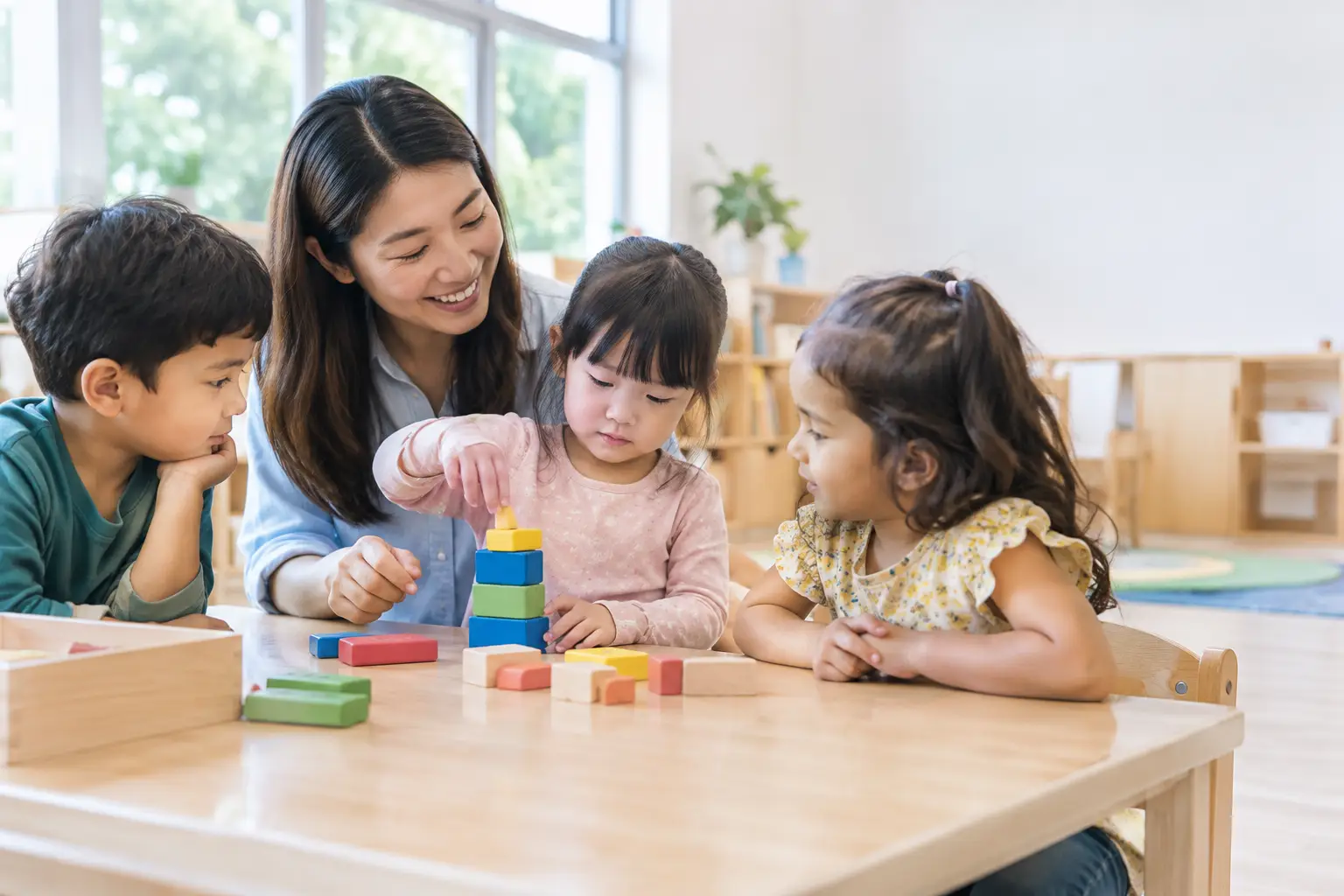
A welcoming classroom does not demand the same response from every child at the same moment. During a lively group activity, one child may sing at the front, another may join the actions from beside the teacher, and another may watch for a few minutes before choosing a puzzle nearby. Each can be moving towards the group in a meaningful way.
Look for educators who notice these small steps. They may sit beside a child at the water tray rather than calling across the room for them to join circle time. They may offer a job with a clear purpose, such as carrying a basket of leaves to the investigation table or placing a toy lorry in a traffic city scene. A useful role often feels less exposing than being asked to perform.
The environment matters too. A room rich with possibilities gives a child something to talk about without placing them directly in the spotlight. A shell, a seedling, a magnifying glass, a ramp for rolling vehicles or a bowl of muddy water waiting to be filtered can become a shared focus.
The child does not have to begin with, “Hello, I want to play.” They can begin with, “Why is this water brown?” That is one reason experiential learning can be especially generous to children who take time to settle. Real materials give hands something to do and minds something to investigate. Conversation can emerge naturally while children mix, build, sort, plant, pour and test.
Gentle support is different from stepping back
There is a balance to seek. An adult who constantly speaks for a quiet child may unintentionally tell them that their own voice is not needed. Yet an adult who simply says, “They will join when ready,” without offering a bridge can leave them isolated.
Thoughtful support sits between those extremes. It might sound like, “Would you like to show Amir where the smooth stones go?” or “You can hold the funnel while I pour.” The adult stays close enough to offer safety, but leaves room for the child to respond. Over time, these ordinary exchanges can build confidence more honestly than a forced introduction ever could.
Watch the transition, not only the classroom
The first weeks of preschool are a transition for the whole family. A child who seemed cheerful during a school visit may still find the first separation difficult. Another may walk in confidently for several days, then suddenly resist once the newness has worn off. Neither response tells you everything about how the year will unfold.
Ask how a preschool approaches arrival. Is there a familiar educator who greets children? Can a child settle through a predictable first activity? Is there time to reconnect after a busy drop off, rather than an expectation that everyone immediately joins the group?
Predictability can be deeply reassuring. Children often cope better when they know the rhythm of the morning: put away belongings, choose an activity, gather for a story, wash hands, eat and play outdoors. The routine need not feel rigid. It simply gives a child a map when everything else is still new.
Parents also play a part in making goodbyes clear and calm. A long, uncertain farewell can be harder than a short, loving ritual repeated each day. It is reasonable to ask educators how they prefer families to manage arrival, then work together rather than trying to solve the adjustment alone at the gate.
Questions worth asking on a school visit
A visit can reveal more than polished displays or a cheerful welcome. Notice what happens at child level. Are children free to approach materials in different ways? Do adults kneel down, listen and respond? Is there a quieter place for a child who needs a pause from the busiest part of the room?
What happens when a child does not join a group activity?
Listen for a response that includes observation, invitation and another opportunity later.
How do teachers help children form early friendships?
Specific examples reveal more than broad reassurance that every child eventually settles.
How is learning made visible?
Shared investigations offer quiet children many natural ways to contribute without performing.
Can active experiences and calm moments exist together?
The right balance depends on how your child responds to people, noise, movement and change.
During a school visit, try to observe the setting while children are moving through an ordinary day. Some children flourish in a highly social, energetic atmosphere. Others need an environment where activity and calm sit alongside each other. There is no single ideal setting. The right one is the place where your child can be known well enough to grow.
Confidence often begins away from the spotlight
We sometimes imagine confidence as a child speaking loudly, volunteering first or walking into a room without looking back. Those can be lovely signs of ease, but they are not the only signs.
Confidence may also be a child asking an educator for help, trying a new texture with one finger, choosing to sit beside a peer, or returning to an activity after watching it the day before.
Connection often comes before participation. A child stretches from the secure feeling of being noticed and understood.
This stretching should not be mistaken for constant comfort. Preschool naturally brings moments of uncertainty: a new song, a shared table, paint on the hands, a turn to wait for, or a question from another child. The aim is not to remove every challenge. It is to make challenge feel manageable, with a trusted adult nearby and a meaningful reason to try.
Let your child's pace inform the choice
Before enrolling, reflect on when your child is most open. Do they warm up after observing from your side? Do they respond to practical activities more readily than conversation? Are they drawn to one or two children rather than a large group? These patterns can help educators welcome them well from the beginning.
Share practical details too: a favourite comfort ritual, a topic that sparks wide eyes, and the sort of words that help when they are unsure. This is not about giving a school a script for your child. It is about offering a starting point for relationship.
A child does not need to arrive at preschool fully confident to be ready for preschool. They need adults who can read quieter signals, classmates with whom connection can slowly take root, and experiences compelling enough to draw them in.
Sometimes the first sign that a child feels at home is not a big wave goodbye. It is a small hand reaching for a magnifying glass, ready to see what it can find.